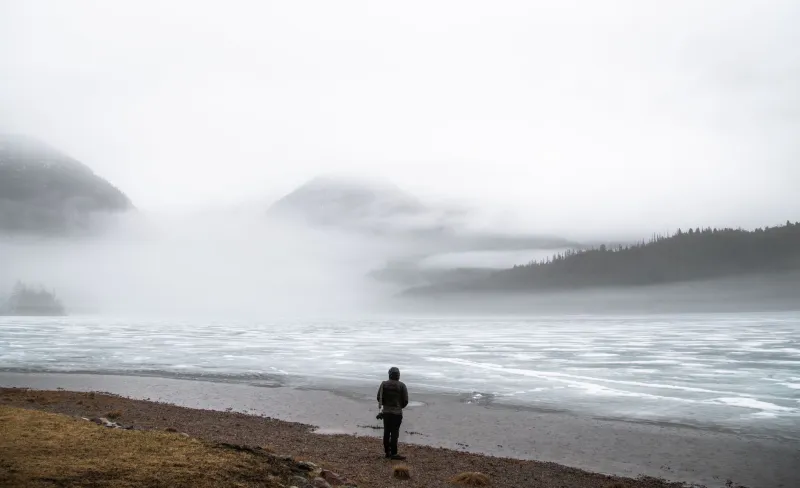
Perfectionism Doesn't Care About Your Zip Code: What Alaska Won't Cure in Your Inner Critic

There is a particular kind of person who moves to Alaska with ambition dressed as escape. They are accomplished, often visibly successful, and quietly exhausted by the standards they have spent a lifetime meeting. The reasoning, rarely stated aloud, goes something like this: If I can build something real in a place this demanding, maybe I will finally be enough.
It is a compelling story. Alaska offers genuine difficulty — brutal winters, logistical complexity, physical challenge, and social isolation that would humble anyone. For the perfectionist, these obstacles feel like an appropriate arena. Surely a place this hard will finally justify the effort, finally quiet the voice that says you have not done enough, been enough, achieved enough.
It does not work that way. And understanding why is more important than the move itself.
The Architecture of Perfectionism
Perfectionism is not, at its core, about high standards. It is about the belief that your worth as a person is contingent upon your performance — and that any gap between where you are and where you think you should be constitutes a personal failure rather than a normal feature of human experience.
This distinction matters enormously. Healthy striving looks forward: I want to improve because growth is meaningful to me. Perfectionism looks backward and sideways simultaneously: I am not where I should be, and that reflects something fundamentally wrong with me.
What perfectionism is not is location-specific. The neural pathways that produce self-critical rumination, that register a missed expectation as a moral failing, that transform a difficult day into evidence of inadequacy — those pathways do not recalibrate when the scenery changes. They travel with you on the Alaska Airlines flight north. They unpack themselves in your new cabin.
How Alaska Becomes the New Stage
The challenge with relocating to a place as vast and demanding as Alaska is that it provides exceptional raw material for perfectionism to work with. Consider the ways this unfolds in practice.
A person who once measured their worth through professional output now measures it through homesteading productivity. Did I split enough wood? Did I learn to preserve food properly? Did I handle the mechanical failure on the snow machine without needing to call anyone? The content of the measuring changes. The measuring itself does not.
Or consider the social dimension. Alaska's communities, particularly in rural areas, carry a strong cultural narrative around self-sufficiency. For someone already prone to viewing any need for help as a weakness, that cultural backdrop can amplify the inner critic rather than silence it. Asking for directions becomes a small shame. Struggling with a first winter becomes evidence of inadequacy. The frontier mythology — which we have examined elsewhere on this site — hands the perfectionist a new set of impossible benchmarks.
Even the wilderness itself can become a measuring stick. I should feel more at peace out here. I should be more grateful. I should have handled that river crossing more gracefully. The word should is perfectionism's native language, and it is remarkably fluent in any environment.
Recognizing the Pattern in Real Time
One of the more disorienting aspects of perfectionism is that it often disguises itself as conscientiousness, ambition, or high standards — qualities that feel virtuous. Identifying it requires a certain willingness to look at the emotional texture of your self-evaluation rather than just its content.
Some questions worth sitting with honestly:
- When you make a mistake in your Alaska life — a poor decision about weather, a failed garden bed, a social misstep in a small community — does your response feel proportionate, or does it carry a weight that lingers far beyond the practical consequence?
- Do you find yourself mentally comparing your adjustment to Alaska against some imagined version of how it should be going?
- Is the satisfaction you anticipated from building this life consistently delayed — always waiting on the next accomplishment before it arrives?
- When someone offers help, does accepting it feel like relief or like evidence of a shortcoming?
These are not rhetorical questions. They are diagnostic ones. The answers reveal whether you are engaging with your Alaska life on its own terms or using it as another arena in which to audition for your own approval.
What Genuine Healing Requires
If perfectionism travels with you, so does the capacity to address it. Geography is neutral on this point — which is actually good news. It means the work is available to you regardless of where you are.
At its most fundamental level, recovering from perfectionism involves decoupling your sense of worth from your performance. This is not a philosophical exercise alone; it is a clinical one. Cognitive-behavioral approaches can help identify and restructure the automatic thoughts that translate imperfection into inadequacy. Acceptance and Commitment Therapy offers tools for relating to the inner critic without being governed by it. Somatic approaches — particularly relevant in a state where physical experience is so central to daily life — can help the nervous system learn that imperfection is not a threat.
Therapy provides something that geographic relocation cannot: a consistent, structured relationship in which the perfectionist patterns can surface, be examined, and gradually be revised. The therapeutic relationship itself becomes the laboratory. When you disappoint your therapist — or believe you have — what happens internally? When a session feels unproductive, what story do you tell yourself? These moments are not failures. They are the material.
The Perspective Worth Carrying North
Alaska is a genuinely remarkable place to live and heal. Its landscapes invite humility. Its communities, when engaged authentically, offer connection that is rare and sustaining. Its rhythms — seasonal, ecological, deeply unhurried in certain respects — can soften a person who has been living at the pace of chronic striving.
But none of that is automatic. The land will not do the psychological work for you. The difficulty will not earn you the self-acceptance you are looking for. The fresh start will not be fresh unless you bring something new to it — not a new setting, but a new relationship with yourself.
If you moved north hoping the distance would quiet your inner critic, you have likely discovered by now that it did not. That discovery, uncomfortable as it is, may be the most useful thing Alaska has offered you so far. It points you toward the actual work — the kind that happens in conversation, in reflection, in the slow and often nonlinear process of changing how you understand your own worth.
That work is available here. It is not available anywhere else, because here is always where you are.
Perspective Practice AK offers individual therapy and coaching services for adults navigating the unique psychological landscape of life in Alaska. If patterns of perfectionism or chronic self-criticism are affecting your wellbeing, we invite you to reach out and begin a conversation.