You Brought Yourself With You: The Hidden Truth Behind Alaska's Promise of Reinvention
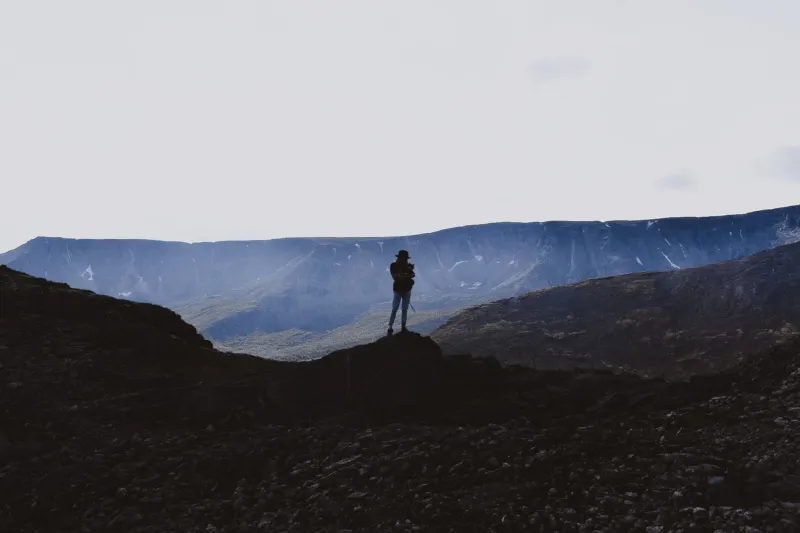
There is a particular kind of hope that travels north. It arrives in the form of a one-way ticket, a lease signed sight unseen, or a truck loaded past capacity on the Alaska Highway. The person carrying it has usually rehearsed a version of the same story: things did not work out where they were, but Alaska—vast, indifferent, and magnificently removed from the familiar—will be different. Alaska will be the place where the old life finally stays behind.
It rarely does.
The Geography of Escape
Alaska occupies a singular position in the American imagination. Its sheer scale—larger than the next three biggest states combined—communicates a kind of psychological permission. If a person can lose themselves in that much wilderness, perhaps they can also lose their anxiety, their grief, their failed relationships, or the quiet sense that something fundamental is broken. The frontier mythology that shaped this country finds its most concentrated expression here, and embedded within that mythology is a seductive premise: that physical distance is a form of emotional resolution.
Clinicians who work in Alaska recognize this pattern with a familiarity that borders on routine. "I would estimate that a meaningful portion of the clients I see in any given year came to Alaska specifically to start over," says one licensed professional counselor who has practiced in the Matanuska-Susitna Valley for more than a decade. "They are not dishonest people. They genuinely believed the move would change something essential. What they discover, sometimes within weeks, is that the internal architecture they were trying to leave behind made the trip with them."
This phenomenon is not unique to Alaska, but Alaska amplifies it. The isolation that initially feels liberating can quickly become a pressure chamber. When external distractions thin out—when there is no packed social calendar, no familiar neighborhood coffee shop, no casual network of acquaintances to fill the silence—what remains is the self. And for individuals who relocated precisely to avoid that encounter, the confrontation can feel overwhelming.
What the Silence Reveals
Margarette, 41, moved to Fairbanks from the Pacific Northwest seven years ago following the dissolution of a long-term marriage. She had spent the final years of her relationship telling herself that geography was the problem—that the city, the social obligations, the proximity to her ex-husband's family had made recovery impossible. Alaska, she reasoned, would provide the clean break that therapy and time had not.
"The first winter nearly destroyed me," she says without hesitation. "Not because of the cold or the dark, though those were genuinely hard. It was because I had nothing left to blame. I had done the thing I said I needed to do. I had made the dramatic change. And I was still the same person with the same patterns and the same fears, sitting alone in an apartment in Fairbanks with nowhere to put any of it."
Margarette eventually began working with a counselor who helped her understand that her move, while not a mistake, had been an act of avoidance dressed as courage. "She told me something I've never forgotten: that running toward something magnificent is still running. The destination doesn't change the mechanism."
Her experience is echoed by long-term residents across the state. Darnell, 54, arrived in Juneau in his late twenties carrying what he now describes as "a full inventory of unprocessed trauma" from a difficult childhood in the rural South. He spent the better part of a decade building a reputation as someone who had reinvented himself—successful, self-sufficient, unbothered by his past. The reputation was largely accurate in external terms. Internally, he says, nothing had moved.
"Alaska gave me the space to perform a version of myself that felt healed," he reflects. "But performance is exhausting, and eventually the performance breaks down. When it did for me, I was in my mid-thirties and completely unprepared for what was underneath."
The Seduction of the Blank Slate
Psychologists refer to the belief that environmental change will resolve psychological distress as a "geographic cure"—a term that is useful precisely because it frames the impulse as a form of self-treatment. Like many self-treatments, it addresses the symptom rather than the source. A person struggling with depression does not become less depressed because their view has changed. A person with an anxious attachment style does not suddenly form secure relationships because their social network is smaller. A person carrying unresolved grief does not grieve more effectively because they are surrounded by mountains.
What geography can do—and this is worth acknowledging honestly—is create conditions in which psychological work becomes more accessible. Removal from chronically stressful environments, separation from relationships that reinforce unhealthy dynamics, and exposure to natural settings with documented restorative effects on the nervous system are all legitimate contributors to wellbeing. Alaska offers these in abundance. The error lies not in coming here, but in expecting the landscape to do the work that only the individual can do.
"I never discourage people from moving to Alaska," says the Mat-Su counselor quoted earlier. "What I try to do is help them be honest about their motivations. There is a difference between moving toward something—toward community, toward a lifestyle that aligns with your values, toward a slower pace—and moving away from an internal experience you don't want to have. The first can be genuinely healthy. The second tends to delay healing rather than initiate it."
When Reinvention Becomes a Practice Rather Than a Performance
The individuals who ultimately find what they came looking for in Alaska are, in many cases, those who eventually stopped looking outward for it. Margarette began therapy in Fairbanks during her second winter and spent three years doing what she describes as "the least glamorous work of my life"—examining the patterns that had shaped her marriage, her self-concept, and her instinct to flee when discomfort became unbearable. She did not leave Alaska. She stopped needing it to save her.
"At some point I realized I actually love it here," she says. "Not because it fixed me, but because once I started doing the real work, I was finally present enough to appreciate where I was."
Darnell arrived at a similar place through a combination of individual therapy and, eventually, participation in a men's support group in Juneau. "Alaska is extraordinary," he says. "But it's extraordinary in the way that a good therapist's office is extraordinary—it creates the conditions for something to happen. It doesn't make the thing happen for you."
This distinction matters enormously. The landscape of Alaska is not inert. It acts on the people who inhabit it, pressing against their assumptions, demanding presence, and occasionally offering the kind of perspective that comes only from standing at the edge of something genuinely immense. But it is not a therapist, and it cannot substitute for one.
The Honest Invitation
For those who arrived in Alaska carrying the quiet hope of a fresh start—and for those still considering the journey—the most useful reframe may be this: the fresh start is available, but it is not located in any particular zip code. It begins at the precise moment a person stops outsourcing their transformation to a place and accepts that the interior work is theirs alone to do.
Alaska will still be here when that moment arrives. So will qualified counselors, therapists, and coaches who understand the specific pressures and possibilities of life in this state. The wilderness is vast enough to hold whatever you bring to it. The question worth sitting with is whether you are ready to bring yourself—all of yourself—into the work of actually healing.
Perspective Practice AK offers individual therapy, counseling, and coaching services tailored to the unique experiences of Alaskans and those who have made Alaska home. If you are ready to move beyond the performance of reinvention and into the practice of genuine change, we invite you to reach out.